The Hidden Costs of Credit-Based AI Writing Tools
erere
6 min read
Treating veteran estimator intuition as an irreplaceable craft feels reassuring, but it quietly caps a machine shop's throughput and enterprise value. Relying on unwritten mental math creates severe manufacturing estimating bottlenecks that stall production before raw material ever reaches a spindle. Profitable scaling requires converting undocumented machinist heuristics into shared digital rules before key talent walks out the door.
For decades, small-to-medium job shops have treated quoting as personal tradecraft rather than an operational discipline. That mindset turns senior personnel into administrative chokepoints and leaves the business exposed when retirement nears.
The Dangerous Trap of Head-Calculated Machine Shop Quoting
Every custom contract machining business has a version of the same bottleneck: a towering stack of prints sitting on one senior estimator's desk. That individual has spent decades listening to chatter on the shop floor, memorizing which vertical machining center holds bore tolerances on 4140 steel, and knowing precisely how much extra cycle time to pad for deep-pocket clearing. While that experience is invaluable, sequestering it inside a single skull turns an asset into an existential vulnerability.
When machine shop tribal knowledge lives exclusively in personal notebooks and memory, growth hits a hard ceiling. An estimator can only review a finite number of blueprints per day. As request for quote (RFQ) volumes rise, the shop faces a painful choice: decline work, quote blindly using rough square-inch formulas, or let response times drift into weeks. The problem intensifies as senior machinists approach retirement. When a veteran who handles the vast majority of shop bids departs without documenting runout formulas and setup allowances, decades of operational capability leave with them.
Gut-Feel Pricing Destroys Margins and Win Rates
Intuitive pricing produces massive bid variance on the exact same geometry. A veteran quoting a multi-axis titanium bracket on a quiet Tuesday morning might price the job with aggressive cycle times and tight margins to win floor work. That same estimator, reviewing the identical print on a hectic Friday afternoon while troubleshooting a scrapped batch of parts, will instinctively pad setups, double run times, and price the job out of contention.
This inconsistency eats profits from both directions. When mental math underestimates tool deflection or chip clearing in tight cavities, the shop wins unprofitable work that ties up five-axis spindles for weeks. When gut feel overestimates cycle times on straightforward turning jobs, the shop loses bread-and-butter contracts to leaner regional competitors. Setup hours, specialized fixturing, perishable tooling wear, and scrap allowances are routinely miscalculated or forgotten when an estimate relies on mental shorthand rather than a structured calculation model.
| Estimating Dimension | Mental Math & Tribal Heuristics | Standardized Digital Estimation |
|---|---|---|
| Cycle Time Calculation | Estimated from memory; varies by day and workload | Driven by geometry, feeds, speeds, and documented machine limits |
| Tooling & Scrap Capture | Frequently omitted or buried under arbitrary lump-sum pads | Itemized by material hardness, feature complexity, and cut depth |
| Quote Consistency | High variance between different estimators or days of the week | Repeatable margins across identical parts regardless of who runs the quote |
| Knowledge Transfer | Requires years of shadowing a senior machinist | Junior estimators apply vetted shop logic within weeks |
Growth Stalls When Quote Speed Depends on One Desk
Modern OEM procurement teams routinely evaluate suppliers on responsiveness before they ever inspect part quality. Automotive, aerospace, and defense buyers operating on compressed release schedules expect turnaround within a day or two. When a shop relies on manual reviews and custom calculations for every line item, machine shop quote turnaround time frequently drifts past a week. By the time that bid reaches the buyer's inbox, the contract has already been awarded to a shop that returned pricing the next morning.
These manufacturing estimating bottlenecks also cripple talent development. Shop owners cannot hire junior estimators or cross-train front-office staff because the shop lacks documented rules to teach them. New hires are forced into months of passive shadowing, unable to release a single quote without a senior machinist signing off on every speed, feed, and setup assumption. The business remains trapped in a single-desk holding pattern, losing high-margin work to competitors that have streamlined their intake.
Why Experience Versus Software Is a False Choice
Machinists often resist digital quoting systems because generic software presets ignore real-world shop floor conditions. They are right to distrust out-of-the-box defaults: a catalog surface feet per minute recommendation rarely survives contact with an older spindle or an unrigid custom fixture. The objective is not to replace seasoned tradespeople with generic algorithms, but to digitize machine shop quoting by using their specific shop math as the software engine.
Digitizing the quoting workflow captures proprietary shop physics: specific machine capabilities, proven runout tolerances, feed deratings for thin-walled aluminum, and historical fixture changeover times. When senior machinists see their personal rules of thumb embedded into software logic, they stop acting as manual data-entry clerks. Instead of calculating routine run times by hand, veteran machinists can direct their energy toward high-value manufacturing problems, like optimizing complex multi-axis toolpaths and designing efficient production fixturing.
Practical Steps to Extract and Codify Shop Floor Heuristics
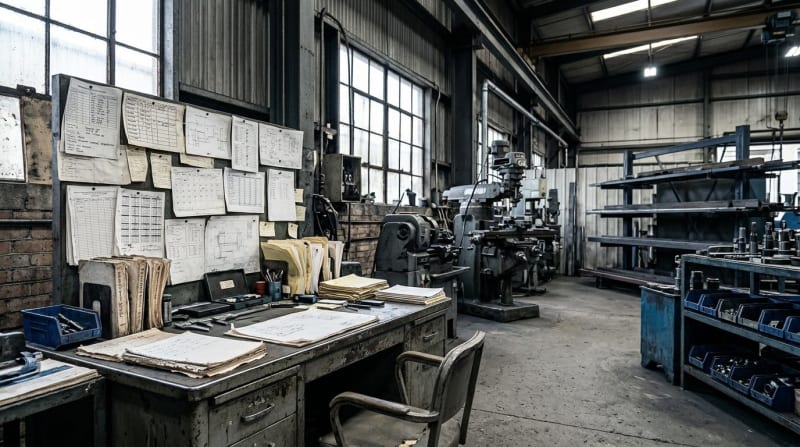
Establishing job shop estimating best practices begins with extracting the calculations hidden across desk blotters, personal spreadsheets, and worn notebooks. Codifying machine shop tribal knowledge requires a clear sequence:
First, group historical jobs into part families like turned shafts, prismatic milled plates, and thin-walled enclosures. Compare the original quoted cycle times against actual spindle hours recorded in machine logs to highlight where personal memory differed from shop reality.
Second, build standardized material and tooling lookup tables. Document the exact feed and speed deratings senior machinists use on tough alloys like 316 stainless steel, alongside realistic tool wear rates. Setting clear part-per-insert expectations converts personal tool-life intuition into repeatable shop standards.
Third, establish explicit setup formulas based on workholding complexity. Instead of letting estimators apply arbitrary flat fees, define set hours for specific tasks: indicating a four-jaw chuck, zeroing a horizontal tombstone, or milling custom soft jaws. Include designated first-article inspection allowances for close-tolerance jobs.
Fourth, run validation trials by having junior estimators price completed jobs with the new formula matrices. Comparing their numbers against actual run times lets senior machinists calibrate the rules without returning to undocumented guesswork.
Once a shop streamlines estimating mechanics, faster turnaround frees up floor capacity. The next step is maintaining a steady inflow of qualified RFQs from commercial procurement teams searching for specialized machining capabilities. Using Trendhopper to automate technical blog publishing helps job shops attract targeted organic search traffic without pulling engineers away from production. Owners evaluating automated growth software can review how to choose SEO blog automation software on a small business budget or consult autopilot SEO blog tools compared across Koala AI, Arvow, SEObot, Outrank, and Trendhopper to balance intake growth with operational overhead.
Converting machine shop tribal knowledge into shared digital rules protects the business from sudden turnover while increasing company value. When individual calculations become permanent operating systems, your facility quotes faster, protects margins, and scales sustainably.